

By Johan Karlsson, Managing Director, Better Shelter, published in Architecture and Technology Volume II: Cities in Climate Crisis, 2025, by the Norman Foster Foundation
Home is our safest place. It is where we build our lives and hold our most tender memories. When we are forced to flee, that sense of safety disappears. We live through a shift that cannot be ignored. Crises driven by conflict and climate are becoming more frequent, more complex and more prolonged. There is no sign that this trend will reverse.When we founded Better Shelter, around forty million people were displaced. A decade later, that number has tripled. More than one hundred million people are now without a secure place to call home. And for many, their shelter is both temporary and long-term at the same time.
At Better Shelter we have provided more than eighty thousand temporary structures in over eighty countries. Most of our work takes place in conflict zones and disaster-prone aid is essential for survival and recovery. Our work in these contexts goes beyond housing. It includes schools, libraries, early childhood centres, reception points; structures that allow communities to function, even in the middle of crisis. I believe the design and architecture community has a vital role to play in shaping a better humanitarian response and in creating the conditions for safety, dignity and recovery. I am here to share what we have learned so far, and the obstacles we still face. Most of all, I hope to encourage and invite you to step into this field, to avoid some of the mistakes we have made, and to work alongside us to make humanitarian response more effective—and more human.
From Flat-Pack Furniture to Flat-Pack Shelter
I finished a Master’s in Textiles and Industrial Design in 2008, right as the global financial crisis wiped out most job advertisements. Like many Swedish designers, I turned to freelancing, working on flat-pack furniture and home appliances, experimenting with new materials and production methods. Then, one project changed everything.
It was an assignment to improve refugee tents used after earthquakes in the mountains of Pakistan. The tents we were meant to upgrade looked like something from my grandmother’s camping trips: heavy, outdated, barely suited for the realities they were meant to face.
While working on the project, I came across a fact that stopped me in my tracks; the average time spent in displacement was already over seventeen years. These were not stopgap shelters. People were raising children in them, growing old in them. And there I was, tweaking the seams of a military-style tent that might last six months if lucky. It was a disconnect between humanitarian practice and the tools of modern design and manufacturing. I could not unsee it. So, I reached out to the IKEA Foundation (the philanthropic arm of the Swedish flat-pack giant) and asked if they would help close that gap. They agreed. Together, we brought in the United Nations Refugee Agency to make sure we were solving the right problem, not just the one we thought we saw.

The Relief Housing Unit (RHU)
The idea was simple, maybe even naive: What if displaced families could build a shelter the way you build a Billy bookcase? Flat pack, no special tools, no engineers required. A shelter that could be deployed quickly in an emergency, but built to last—durable, adaptable and upgradeable over time. That became the Relief Housing Unit, or RHU: a modular, flatpacked shelter that could meet urgent needs in the first days of displacement but still offer safety and dignity in the years that follow. We designed the RHU in partnership with the United Nations High Commissioner for Refugees (UNHCR) and the IKEA Foundation, with input from displaced communities who helped us understand how shelter really works in practice. International manufacturers helped us scale it efficiently and keep costs as low as possible. The result was not perfect, but it was a start. A shelter built for the crisis, and for everything that comes after.

Letting the User Finish the Design
A home reflects the culture and climate it stands in. The needs of a family in Ukraine differ from those in Syria or Venezuela. And yet, in emergencies, we are often asked to design a one-size-fits-all solution—knowing full well that such a thing does not exist. That is the paradox.
During our first field tests in 2013, this became painfully clear. The wide doors that were appreciated in Iraq for ventilation were criticised in Dollo Ado for offering no privacy. Floors that worked in cold, wet Sweden made the shelters unbearably hot in the Ethiopian sun, where people were used to cooling the interior by pouring water on the floor—an evaporative cooling method that our designs accidentally blocked.
Then there is the question of space. The international humanitarian planning standard assumes that for a household of five, each person is entitled to 3.5 square metres of habitable space. But that is rarely the case in reality. Some households were significantly larger with ten or more people under one roof. Others consisted of a single person. A fixed model simply does not fit. So what is the answer? It is not to tailor-make shelters for every context, we cannot, but we can design for choice. Modularity lets the same parts serve different needs. A wall can be replaced by a door. A single unit can stand alone, or several can connect. Like an IKEA kitchen, the parts are fixed, but the outcome is flexible. The real design work begins when the product leaves the warehouse. That is when families place the door where they want airflow, or where they need privacy. And the shelter still works.
More than Survival: What Makes a Home
Shelter is often described as a life-saving need, and it is. But survival is only the beginning. Again and again, we see that displaced people seek more than protection from the elements. They seek connection, culture and a momentary escape from crisis.
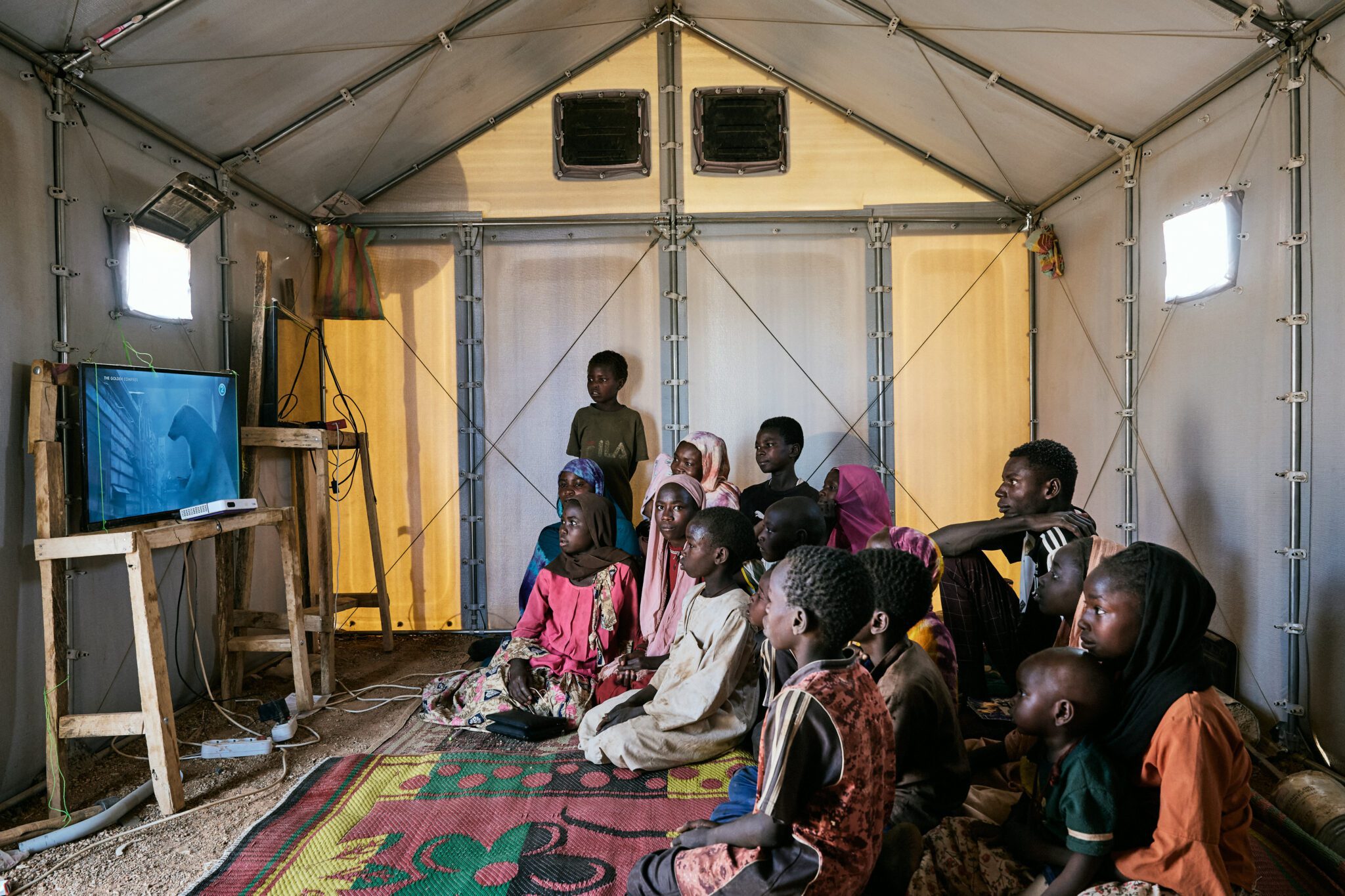
In eastern Chad, nineteen-year-old Mohammad runs a ‘TV club’ from a temporary shelter. On movie nights, he pulls a generator across the sand, stretches an extension cord far enough to keep the engine noise away, and flips through channels until he finds something to share. Within minutes, children fill the space, sitting quietly on plastic mats, watching an animated polar bear talk to a girl on screen.
Mohammad charges five cents a head, just enough to cover diesel. People of all ages come to watch football, Bollywood or the latest Turkish dramas. His best friend, also a teenager, who lives alone after losing both parents in the conflict, often joins him. They sit under the dish antennae outside, talk a little, then give in to the glow of the screen.
A shelter like this may be designed for survival, but it becomes something more: a place for expression, escape and belonging.
Mohammad’s story reminds us that the measure of a shelter is not just whether it protects us—it is whether it makes space for life to begin again.
‘Not in My Backyard’
A hard learned lesson came in Lebanon’s Bekaa Valley. Our humanitarian partners had done their homework. They had secured approvals to set up our shelters from the mayor and the local imam. But they forgot to speak to the neighbours. Halfway through assembling the shelters, a pickup truck arrived. The men inside were armed and angry. Our structures, they said, looked too permanent, and were too close. Tear them down, or they would.
This was not about design flaws. It was about fear, land and politics. And it is not unique to Lebanon. In 2014, behind the row houses in the Stockholm suburb where I live, a group of migrants set up a temporary camp in the forest. The neighbours said the same thing I have heard in settings around the world: ‘Refugees are welcome. But, just not here, not near our gardens or our kids’ playground’.
It may sound cynical, but it is real. Shelter is never just about shelter. It is about who belongs, and who decides. That is why even the most practical solutions, like a solid foundation, are often rejected. They signal permanence. So, the challenge becomes this: to design a shelter that can last, without looking like it will. It is a strange brief, and one we wish we did not have to meet.
What Can You Build for Fifty Dollars?
One of the harder lessons is this: Humanitarian aid is chronically underfunded. Shelter, in particular, is often the least prioritised sector. In many operations, the available shelter budget is as low as fifty dollars per person. And with growing needs, that figure is not going up anytime soon.
Aid funding is not distributed equally either. Some responses are well resourced, typically those close to donor countries or aligned with their political interests. But many operations are left to run on scraps. In some cases, the shelter budget is effectively non-existent.
As architects and designers, we could, and should, argue for more investment in the built environment. But we also need to be realistic. A standard emergency tent costs around $500. An RHU is about $1,500. In most operations today, neither option is affordable.
We cannot design as if money is coming when it is not. We have to work with what exists. That is the constraint and the responsibility.
Crisis Lasts for Long, but Humanitarian Assistance Does Not
Emergency money comes fast and loud (think Haiti, 2010) but disappears just as quickly. Since the UNHCR was founded in 1950, I am not aware of a single refugee camp that has closed in twelve months. The funding, however, often assumes they will. Media shifts, headlines fade and the budget follows. Life-saving aid arrives, but if it only lasts a year, and the crisis lasts a decade, we have just delayed the same problem.
That is why humanitarian shelter cannot only be about survival. It has to create value beyond the emergency. What we send in the first seventy-two hours should still matter in year five or ten. This is not just good design, it is resilience.
In the humanitarian world, this is the referred to as the humanitarian-development nexus, the idea that emergency relief should link to recovery and long-term development. Understanding shelter not as a single event, but as a process along this timeline, is central to meaningful humanitarian design.
Human Needs versus the Humanitarian System
When a roof disappears, whether torn off by a cyclone or blown apart by shelling, the cold that follows feels the same. But the humanitarian system does not treat it that way.
In simplified terms, when people flee conflict, the UNHCR typically leads the response; when disaster strikes, it is the Red Cross and Red Crescent (IFRC). Around them, large international nongovernmental organisations (NGOs) gather, proposals in hand. Only after roles are negotiated and budgets signed off does support reach the local organisations, the same people who were pulling survivors from the rubble before the coordination calls even began.
This division, mostly defined by whether someone crosses a border or not, shapes everything. It decides who leads, what rules apply, and what kind of shelter a family receives. But grief, rain and sleepless children do not care who is in charge.
There is growing consensus that this needs to change. Power must shift from global actors to local communities and organisations—the people who understand the context, carry the risk and stay long after the headlines move on. But that shift is slow, and the system we have today still holds most of the cards.
To be frank, if we do not adapt our work to the reality of how these few United Nations agencies and international nongovernmental organisations (INGOs) operate, our most thoughtful designs may never leave the drawing board. And the people who need them most will keep waiting.
As humanitarian designers, our responsibility is twofold: to understand the system well enough to move within it, and to design in ways that challenge and stretch it. People must come before the process. Local knowledge must guide global response. And every shelter we design should point toward the kind of system we want to help build.
The Syria Lesson: A Decade of Aid on a One-Year Timer
Northwest Syria is one of the clearest examples of the humanitarian paradox that we have been describing. As of 2022, more than four million people were living there, trapped between the regime they fled in Damascus and a sealed Turkish border. They are not refugees in the legal sense, but internally displaced. That distinction keeps aid negotiators up at night.
Legally, they remain under the jurisdiction of the Syrian state, which in this case is the very regime they fled. Every June, the United Nations debates whether to continue cross-border aid. But the United Nations is not one single voice. These decisions land in the Security Council, where global politics take over. Russia, a key ally of the Syrian regime, has repeatedly pushed to end international assistance. Other countries push to extend it. The result is a fragile compromise: a one-year extension, typically approved at the last minute.
This short-termism shapes everything. Aid agencies cannot plan long-term. So, every year, we send another wave of emergency tents knowing they will not last. The war outlasts the emergency shelter. Idlib is an extreme example, but this story plays out in other crises too.
To make matters worse, most displaced families in northwest Syria do not own the land they live on. Without land rights, they are not allowed to build permanent structures, even though that would be the safer, more dignified and more cost-effective option. Politics trumps practicality. To improve the situation, we have worked with United Nations partners and local organisations to deliver over ten thousand Relief Housing Units. Because they are classified as temporary, they are allowed under current regulations. The flat-packed form makes them easy to move through the restricted cross-border corridors. And while temporary on paper, they are built to last. Families upgrade them over time—adding walls, insulating panels, shade and ventilation. The RHU becomes a living structure that lasts, adapted by the people who inhabit it.
What We’ve Learned So Far (and Why We Are Still Here)
After more than a decade working in humanitarian shelter, we have come to believe that we have to work with the system we have, while designing for the one we want. We should follow the global consensus to build locally whenever possible; it is usually more affordable, more appropriate to the context and it strengthens the community’s ability to recover. Prefabricated shelters like the RHU are not a universal solution, but they play a vital role when local markets are disrupted. They are the last safety net. And when designed with care, they can evolve from emergency tools into long-term assets.
Through this work, we have learned that shelter must be modular from the beginning, strong enough to endure, light enough to be politically accepted, affordable at scale, upgradeable with local materials and skills and—most importantly—designed to hand over agency to the people who will live in it.
When we get this right, we can stop replacing tents with more tents and start creating shelter systems that grow in value over time. But prefabricated shelter is just one small corner of the humanitarianbuilt environment. As architects and designers, we have tools that reach far beyond the structure itself. There is still so much to be done, and this is an open invitation to step in.
Postscript: A Shelter for Return
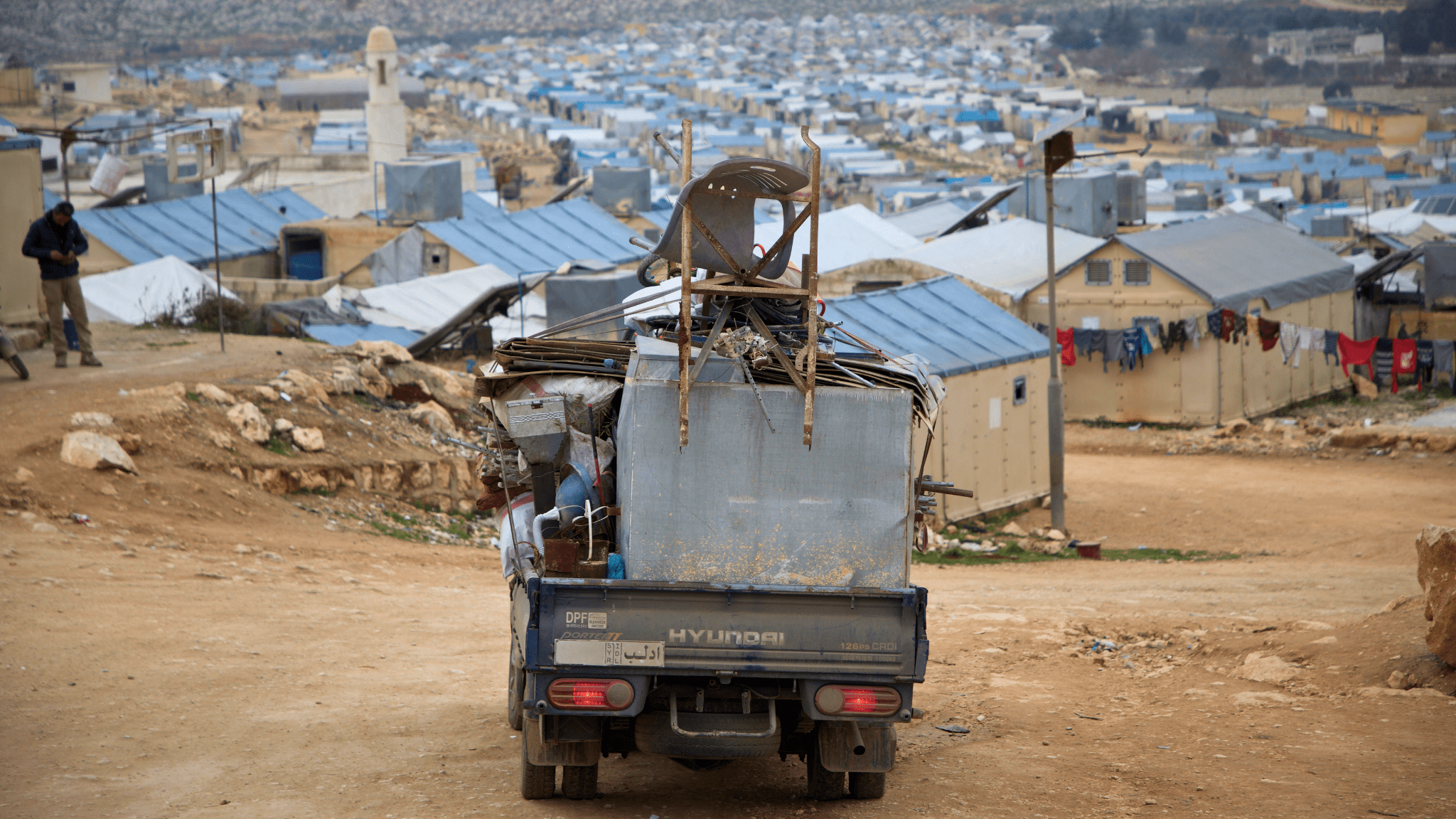
The following text was not part of the original lecture at the Norman Foster Foundation, but it is an important development worth sharing. On December 8, 2024, the Assad regime in Syria fell, and a new government is beginning to take shape. The shift has made it possible for many families to return home safely for the first time in over a decade. But returning does not mean returning to a house. In many cases, there is nothing left, just a plot of land, a damaged structure or ruins.
Here again, the mobility of the RHU has proven valuable. Families are dismantling their shelters and taking them back with them, to use as transitional housing while they rebuild. A shelter that was once a temporary shelter in displacement becomes a steppingstone on the way home.
By Johan Karlsson, Managing Director, Better Shelter, published in Architecture and Technology Volume II: Cities in Climate Crisis, 2025, by the Norman Foster Foundation


