
For decades, much of the world’s wool has been treated as waste, despite its natural qualities. Today, The Swedish Wool Initiative, led by Axfoundation and Dalarna Science Park, is showing another path. More than 30 new products and prototypes now demonstrate how Swedish wool can support a circular industry, from clothing and furniture to building insulation and garden pellets.
A central step is the new Swedish Wool Standard, a national system that classifies wool based on fibre properties instead of sheep breed. This makes it possible to trade and process wool at scale and to combine wool from different farms while keeping quality consistent.
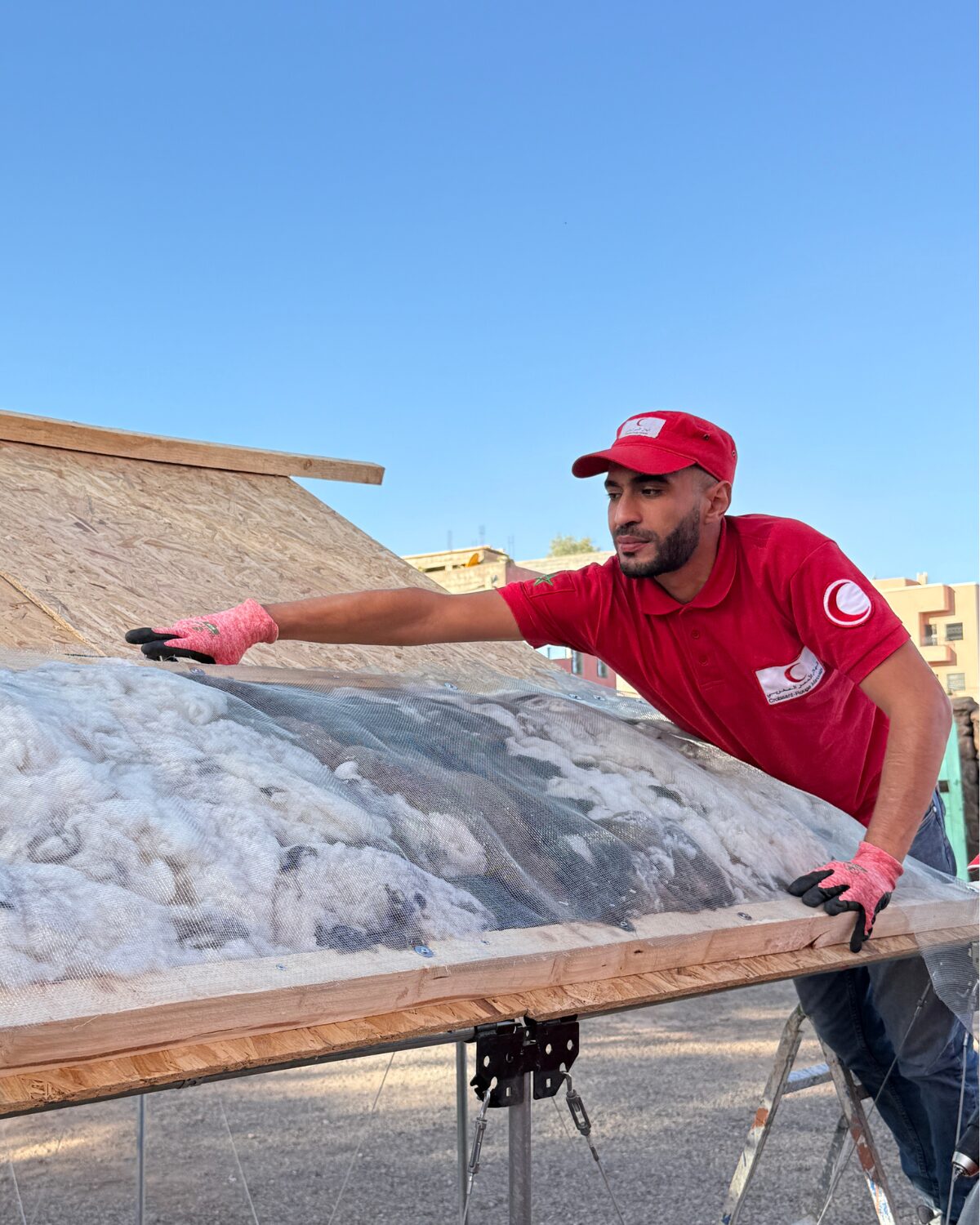
For Better Shelter, this creates promising opportunities. We are testing Swedish wool, both as loose fibres and in felted form, as insulation in our shelters, with the hypothesis that wool is readily available in many regions where our shelters are used and represents a natural, circular and local material with very strong insulating properties. Early trials have taken place with IFRC in Morocco (pictured above). Upcoming tests in Sweden will further explore how felted wool can be combined with waterproof tarpaulin, in collaboration with Axfoundation.
“Circular, regenerative materials like wool can make humanitarian shelters not only more sustainable, but also more deeply connected to the communities they serve, returning decision-making to those most affected. To me, this is what resilience looks like in practice: using what is local, renewable, and capable of supporting both people and ecosystems simultaneously. It’s also about the materials, knowledge, and practices that communities already possess. Where the economic, the social, and the environmental converge, creating solutions that are alive, grounded, and enduring.”
Eva Porcuna Ferrer, Design Engineer, Better Shelter

Wool has several advantages as a building material. It is renewable, bio-based, suitable for recycling, and provides effective thermal insulation. These qualities align with Better Shelter’s work to reduce environmental impact and create safer, more comfortable temporary homes.
A stronger Swedish and international wool industry can support more sustainable material flows and reduce reliance on imported insulation. Better Shelter looks forward to contributing to these developments and to learning how locally sourced wool can support better shelter solutions for people in need.
More info about the initiative here.


